Coin-buying economics · Editorial field guide
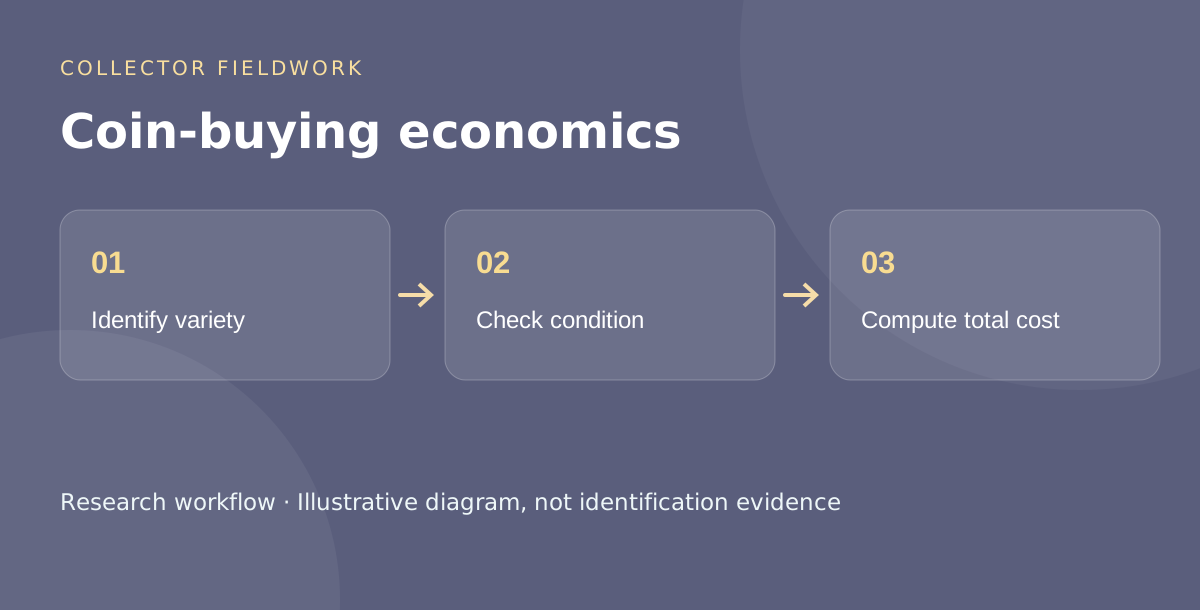
Buying Your First Morgan Dollar: A Seller-Question Checklist
Affiliate disclosure: Some marketplace links earn a commission if you buy. Listings are seller descriptions—not independent authentication or proof of value.
Quick answer. The first Morgan dollar conversation is a lesson in restraint: asking about date, mint and surfaces is more useful than asking “what’s the rarest one?” The practical goal here is date, mint, surface and authentication decision path, while keeping uncertain details visibly uncertain.
This guide is for someone handling the exact coin and transaction—whether deciding what to buy, documenting a family find, or preparing a defensible sale description. The key is to investigate the exact example rather than relying on a broad category name.
What to establish first
The question: Date, mint, surface and authentication decision path. This is more specific than “Is it rare?” or “Is it worth anything?” because it can be answered from recorded evidence. The first Morgan dollar conversation is a lesson in restraint: asking about date, mint and surfaces is more useful than asking “what’s the rarest one?”
Before spending time on a valuation, establish which version or condition is actually involved. The practical risk is using asking prices as sold prices, cleaning a coin, or neglecting buyer fees. Neither age nor an attractive seller story resolves that uncertainty.
In-depth field guide
The Morgan silver dollar is an inviting first collectible: large, recognizable, and plentiful enough for beginners to compare examples. The challenge is not choosing the most dramatic date or the shiniest coin. It is buying a clearly identified piece, at a price that makes sense for its actual condition and authenticity risk.
Decide what you want before searching
Are you looking for one representative coin, a particular date and mint mark, a certified type example, or a coin you can examine closely in hand? These are different purchases. A modest common-date example with honest wear may be a better first learning piece than a supposedly rare coin offered at an unexplained bargain.
Set an all-in budget that includes shipping, taxes, return costs if any, and authentication uncertainty. Do not spend the entire amount on an auction hammer price and discover the fees afterward.
Ask for the date, mint mark and exact images
Make sure you can read both sides of the actual coin. Sellers sometimes use stock photographs or images that hide the reverse. On a Morgan dollar, the date and mint identification matter; so do evidence of wear, cleaning, damage, and possible alteration. Ask for clear photos under neutral light, including angled shots that show luster and surface marks.
Avoid interpreting high contrast, dramatic toning, or unusually bright surfaces as proof of a high grade. Digital processing and lighting can change appearances substantially. If a coin is already graded, verify the certification with the issuing service and compare the visible item with the recorded description.
The cleaning problem
A polished or chemically cleaned coin can be attractive to a new buyer but less desirable to many collectors. Hairlines, unnatural brightness, residues, or uneven color may warrant questions. Do not attempt cleaning of your own: PCGS recommends against cleaning collectible coins because it can damage surfaces and reduce value.
If a seller describes an uncertified coin as “MS65” or “uncirculated,” treat that as a seller opinion rather than a professional assessment. Ask what supports the claim and compare with appropriately graded examples.
Compare sales of truly similar coins
Start with the exact date and mint mark, then narrow by whether examples are raw or certified, their condition, and any noted defects. A certified, attractive example and a damaged ungraded example should not be averaged together into a fictional “market price.” Check completed transactions and the date of each sale, not just active listings.
PCGS CoinFacts and auction records can help identify the issue and show relevant population or transaction history. A reference guide is not a dealer's guaranteed buyback offer. Be suspicious of an exact price derived solely from a generalized online chart.
Return terms are part of the coin
Read the seller's return window, authenticity policy, photographs policy, and handling of third-party review before purchase. Ask whether the coin shown is the actual coin shipped. For a more valuable purchase, buying from an established dealer with clear policies may justify a premium over a hard-to-evaluate private listing.
A first-purchase worksheet
Write down the issue, date/mint, desired condition, seller, asking price, estimated fees, evidence supporting authenticity, closest recent completed sales, and the reason you want this particular example. If a box remains blank, you have a useful question to ask before checkout.
The objective is to finish with a coin you understand and can accurately describe—not merely a story about a bargain.
Make the description testable
Turn each attractive adjective into an observable question. “Rare” becomes “which exact edition and how was it identified?” “Original” becomes “which components are documented?” “Works” becomes “what demonstration was performed?” “Unsearched” becomes “what part of the custody history is known?” A claim that cannot be tested belongs in the uncertainty column.
Keep a clean distinction between facts visible in photos, seller representations, third-party opinions and unresolved questions. That gives a future buyer or appraiser a way to retrace the reasoning.
The photographs or records that would settle it
Ask for obverse/reverse, rim, label if graded, exact surface detail in straight light. A photograph should be useful for diagnosis rather than just flattering. Save uncropped originals and label the views consistently so a specialist can request an additional angle without losing track of the object.
For Buying Your First Morgan Dollar: A Seller-Question Checklist, a useful listing names the scope of what the seller actually checked: date, mint, surface and authentication decision path. An absent identification detail is different from ordinary cosmetic wear; it can change what object a buyer thinks they are purchasing. Save the seller’s answer beside your own observations.
A comparison worksheet for this exact question
| Question to resolve | Evidence to record | Decision if missing |
|---|---|---|
| Denomination, year, mint mark and major variety | Photograph, catalog reference, seller response or exact observation | Mark as not fully identified; defer valuation. |
| Raw or graded status and authentication scope | Photograph, catalog reference, seller response or exact observation | Use original photo, label or third-party catalog; ask for a closeup. |
| Closeups of surfaces, rim and problem spots | Photograph, catalog reference, seller response or exact observation | Price or sell conservatively; document the uncertainty. |
| Comparable completed-sale dates and conditions | Photograph, catalog reference, seller response or exact observation | Seek specialist review if value materially depends on it. |
An illustrative decision—not a market valuation
Suppose two examples are advertised as the same kind of collectible. One provides denomination, year, mint mark and major variety and raw or graded status and authentication scope; the second uses only the broad category name and a single dramatic photo. The better-documented example is easier to research, return, insure and resell. That does not automatically mean it is worth more. It means fewer important facts are being left to imagination.
For the final purchase calculation, combine the actual bid or price, buyer premium if applicable, taxes, delivery, insurance and any known service costs. Never compare a dealer asking price directly with an auction hammer price. Use the interactive total-cost calculator to model your own numbers; none are represented here as live market quotes.
The non-obvious part
Brighter is not necessarily more collectible. The U.S. Mint cautions that cleaning or polishing can reduce coin value. A brilliant-looking surface may have lost desirable original characteristics; a beginner choosing a Morgan dollar should ask about cleaning rather than admire shine alone. Primary source.
Mistakes to avoid and a safe stopping point
The main trap in this category is using asking prices as sold prices, cleaning a coin, or neglecting buyer fees. Before a purchase or alteration, confirm: (1) the identity, (2) physical condition, (3) documentation, and (4) the financial or legal consequence of being wrong. If any one of those is material but cannot be checked, ask for evidence or decline the transaction.
Editorial accuracy boundary: No fixed price claims. This is a verification requirement, not an assertion that the item under discussion has passed inspection. No unseen object is authenticated, appraised or certified by this guide.
Seller question you can copy into a message
I am researching buying your first morgan dollar: a seller-question checklist. Could you show denomination, year, mint mark and major variety and explain date, mint, surface and authentication decision path? Please distinguish what you checked personally from what came from a previous owner or grading label. I would also appreciate your return terms if the identification is incorrect.
The answer should create something you can verify, not merely a reassuring adjective. If a seller gives a precise limitation (for example, “I have not tested the exact coin and transaction”), record that limitation exactly. It may be honest and useful without proving the condition you need.
Practical questions readers ask
What matters most for buying your first morgan dollar: a seller-question checklist?
The first test is denomination, year, mint mark and major variety, followed by raw or graded status and authentication scope. Those details let you narrow the object down before anyone starts guessing a premium.
What if the listing has too few pictures?
Request an uncropped view that resolves the missing identifying mark or condition question. You can save the listing for later, but do not use its price as a comparable until you know the versions actually match.
Should I repair, clean, open or alter it before asking an expert?
Usually document first. An alteration can remove provenance or condition evidence; fragile items and high-value pieces merit qualified advice. The right treatment depends on material and condition rather than an all-purpose cleaning hack.
Marketplace research after identification
Disclosure: We may earn a commission if you purchase through this eBay link. This does not affect the identification steps or any conclusion above.
Browse relevant eBay listings to inspect — search for “Morgan silver dollar certified.” This is a live search, not a verified offer or completed-sale price. Check the actual listing, seller, legality where relevant, and return terms. For valuations, separately review genuinely comparable sold transactions.
References, research limits and related reading
- United States Mint coin-care information — official or specialist guidance, not a certificate for the item in this article.
Companion guides in this package (publish these routes together):
- How to Read a Coin Dealer Return Policy Before Buying
- Buying Proof Coins: Why Packaging and Haze Matter
- How to Compare a Coin Show Price With Online Sold Results
Collection and buyer education, not individualized appraisal, authentication, legal or investment advice. We have not physically inspected the collectibles described. Affiliate transactions should be independently verified before publication.